
Civic Sweep is one way to help Brooklyn’s street trees. But we only hold this event twice a year. There are many other ways you can keep your street tree healthy.
Well-maintained tree beds are vital for the health and long-term survivability of Park Slope’s 5,000 street trees. Here’s a guide to keeping them healthy.
WATERING & SOIL:
- It is never a bad idea to water your tree, but it’s particularly important during periods of drought or low rainfall. 8-10 gallons a week will help your tree thrive.
- Once or twice a year take a gardeners’ fork or trowel and loosen the top couple of inches of soil to allow rainwater to soak in.
- Mix an inch of compost into the soil to add nutrients that are great for your tree. Spread 2-3 inches of mulch on top of the soil to retain moisture and make your tree bed more attractive. But keep the mulch 6 inches away from the trunk.
- Keep the soil level with or slightly below the sidewalk.
- Garden tools, compost and mulch are not expensive and are available at local hardware stores. You can also get free mulch in early January at Mulchfest.
- Treating the soil will take an hour or two twice a year. This is easy and inexpensive!
- “RESOURCES” below has links to useful websites.
DISCOURAGING DOG WASTE:
- Dog waste (both urine and feces) is harmful to trees and plants.
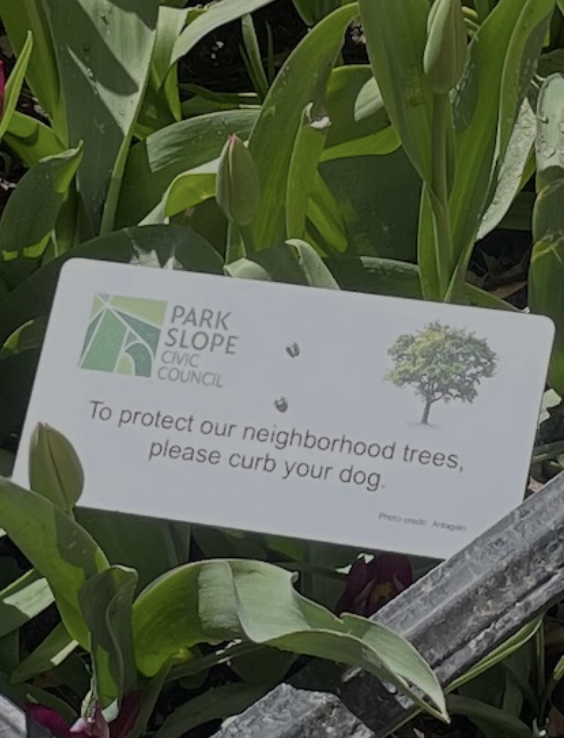
- The Civic Council offers a polite, inoffensive, durable and easily installed tree bed sign for $25. Order them here.
PLANTING:
- Beautifying your tree bed with flowering plants is an amazing way to spruce up the neighborhood.
- Choose small-to-medium sized bulbs or plants that are compatible with our climate and with the amount of sun or shade in your tree bed. The Brooklyn Botanic Garden provides useful info, and a local nursery can also give guidance.
- You’ll also want to remove trash, pull out weeds, and water your plants as needed.
Enjoy and care for your tree bed and encourage others to do the same. If you choose to beautify your street tree, post before and after pictures on social media and tag us (@park_slope_civic_council) or email us (outreach@parkslopeciviccouncil.org). Finally, if you appreciate what the Park Slope Civic Council does for our neighborhood, JOIN US.
We also have information about tree guard and tree bed expansion.
Tree beds provide a home for trees, and tree guards protect them from the stresses of urban life. Here are some tips for installing, maintaining or expanding tree beds/guards, and addition information on sidewalks.
TREE GUARDS
- Tree guards are the best way to keep animals and trampling humans out of your tree bed. They must have only three sides, be 18 inches high, be 12 inches from the curb, and allow water to flow all around. Our “RESOURCES” section below has info about installing tree guards from the Parks Department and from Trees NY, which also has a list of local installers.
- Choosing a design, getting a couple of quotes, and choosing a installer are all pretty simple. You can expect to spend between $750 and $1,500. You can save money by building your own, but a Parks Dept permit is required.
TREE BED EXPANSION:
- Many tree beds are smaller than they should be. Depending on sidewalk width, tree beds should be 3’ or more in width and 8-10’ in length. You can also partner with neighbors on a continuous tree bed connecting two or more trees.
- Two companies that provide tree-bed enlargement services are TreePEP and NYC Tree Pit Services. (The Civic Council makes no recommendation or representation as to the quality of their work.)
REPAIRS AND OTHER TOPICS:
- The Parks Dept website has information on new tree requests, pruning, and the removal of dead trees.
- Tree roots can crack or lift up sidewalks, creating a tripping hazard. Homeowners are responsible for keeping sidewalks in good repair, but if a tree causes the problem, the Parks Department may do the repair or reimburse you for it.
RESOURCES:
- https://www.bbg.org/community/street_trees
- https://vimeo.com/treesnewyork
- www.nycgovparks.org/trees/tree-care
Click here to purchase one of our tree bed signs. Four out of five dogs surveyed said they were avoiding tree beds with these signs.